
· Erin Delaney
Indoor exercise for dogs: why more walking is not the answer
First, one thing to rule out
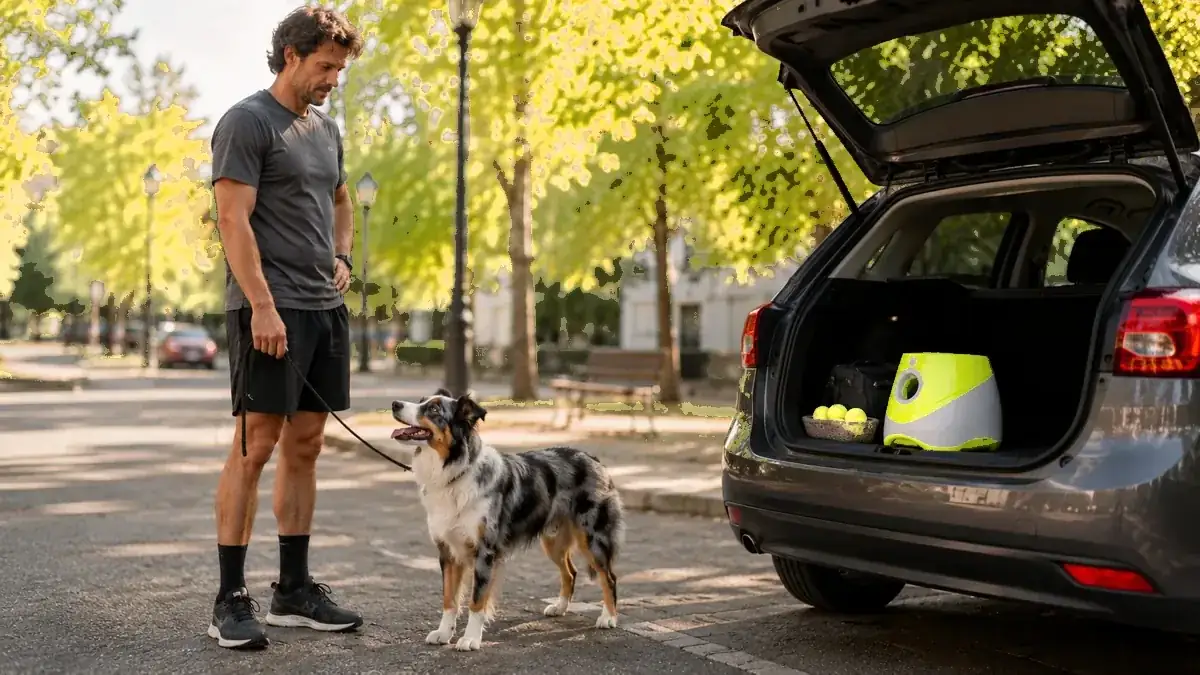
Most "hyperactive" dogs are not hyperactive. They are usually a working breed living a sedentary life, or a young adult between one and three years old, when energy peaks.
Hyperactivity in the clinical sense — hypersensitivity-hyperactivity syndrome — is a rare disorder with specific signs: the dog cannot stop even when exhausted, sleeps very little, does not modulate his bite, and never fully comes down from arousal. If that describes your dog, no toy will be enough: what you need is a veterinary behaviorist, not a blog article.
The rest of this guide is about the first case, which is by far the more common.
Why linear walking fails
Walking is low-intensity endurance work. It is precisely the kind of effort the body adapts to fastest: three weeks are enough for an hour's walk to stop being a notable effort. You increase, he adapts, you increase again. That is training, not expenditure.
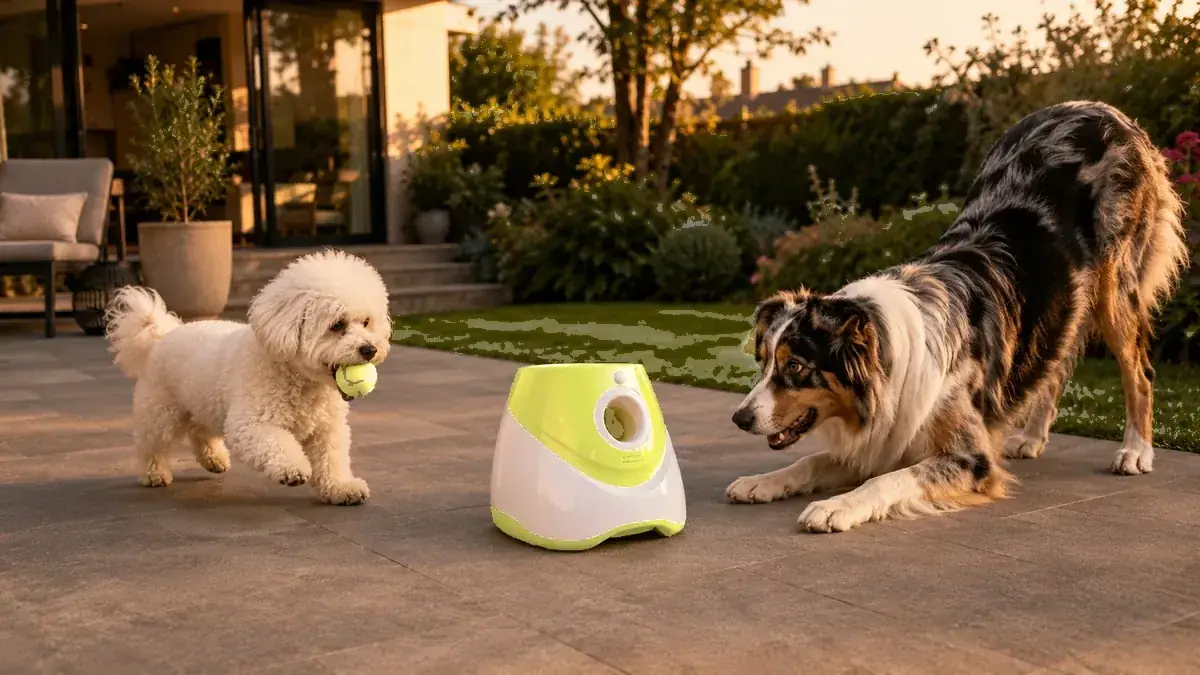
A short explosive effort does the opposite — a twenty-foot sprint, a turn, a stop — and draws on reserves that walking does not touch. Twenty sprints are worth an hour's walk in real fatigue, and they take a quarter of an hour.
Which is why the useful question on a rainy Tuesday is not "how do I walk him more", it is "how do I get twenty sprints out of a hallway".
The five things that work
| What | How long | What it produces | Indoors? |
|---|---|---|---|
| Repeated sprints (fetch) | 15-20 min | Real physical fatigue | Yes, on the short setting |
| Food searching | 10-20 min | Behavioral satiety | Yes |
| Inhibition exercises | 2-5 min | Attention fatigue | Yes |
| Varied ground (slopes, sand) | 30 min | Deep muscular effort | No |
| Supervised social play | 20-30 min | Expenditure plus regulation | No |
Fetch, if you actually do it properly
This is the most effective one and the worst exploited. Real fetch work is fifty to a hundred round trips, not ten. The problem is mechanical: nobody throws a hundred times with any pleasure, and an overhead motion repeated daily eventually hurts. So the session always stops for the wrong reason — the owner's fatigue, not the dog's.
That is the one place where a machine genuinely changes things. An automatic ball launcher sends the ball back 10, 20 or 30 feet for as long as the dog keeps bringing it. The loop runs without you, and the short setting works down a corridor. It also asks the dog to work out that the ball has to go into the chute — so a little thinking comes free with it.
⚠️ One honest caveat: the machine only works once the dog reliably lets go of the ball. That is a separate skill and it takes about a week — the method is here. Buying the machine first and the skill second is the usual order, and the usual disappointment.
Inhibition, the invisible lever
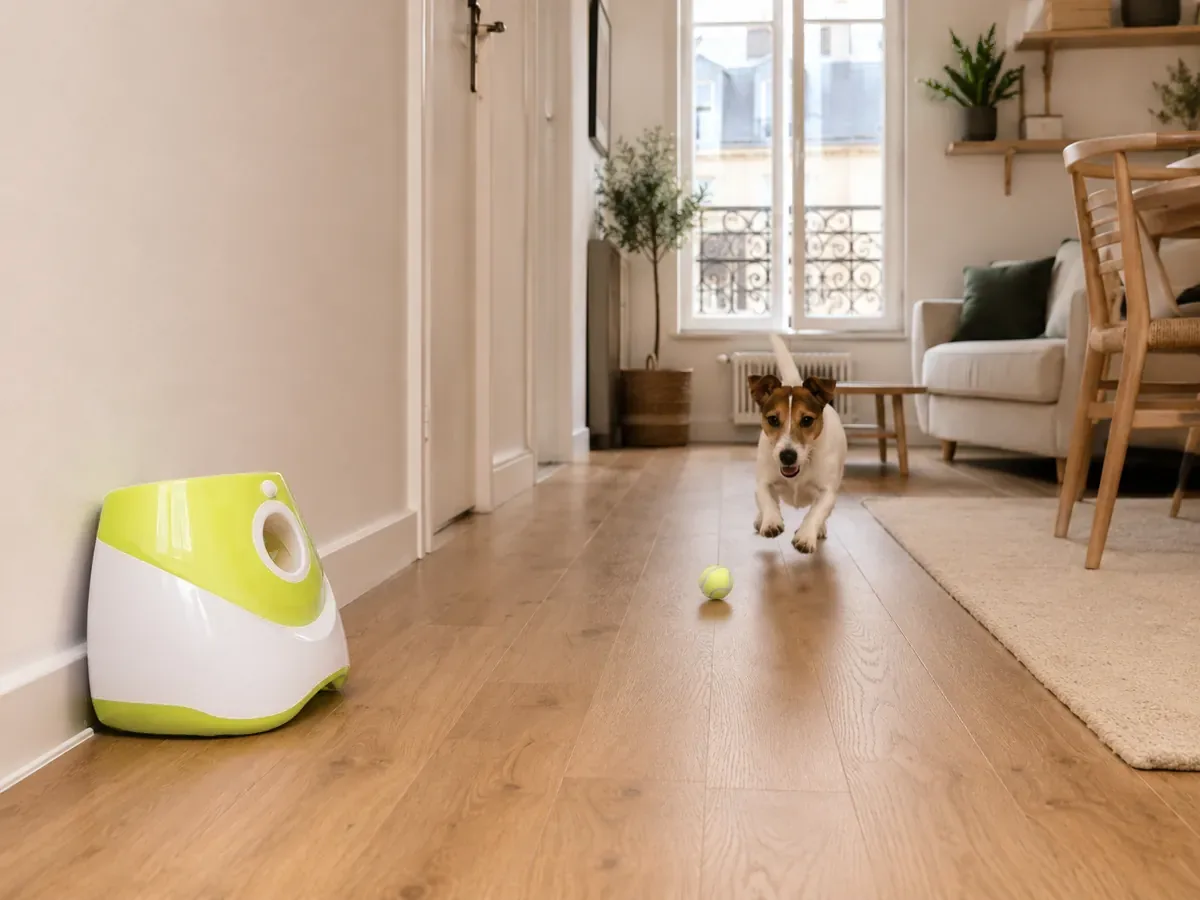
Asking an excited dog to hold still for thirty seconds before you throw costs him more energy than a round trip. It is counter-intuitive, and it is the cheapest thing in this list: it needs no space, no equipment and no weather.
Food searching, on the days you cannot go out
Scatter the meal instead of pouring it. Fifteen minutes of searching against three minutes of swallowing, and it works on a rug as well as on grass. It is the single easiest swap in this article and almost nobody makes it.
A rainy day that actually works
- Morning: scatter breakfast rather than bowl it. Fifteen minutes.
- Midday: ten minutes of fetch on the short setting, down the hallway, with a wait before each throw.
- Afternoon: five minutes of the cup game or a named-object search.
- Evening: a short outing for sniffing — not for distance.
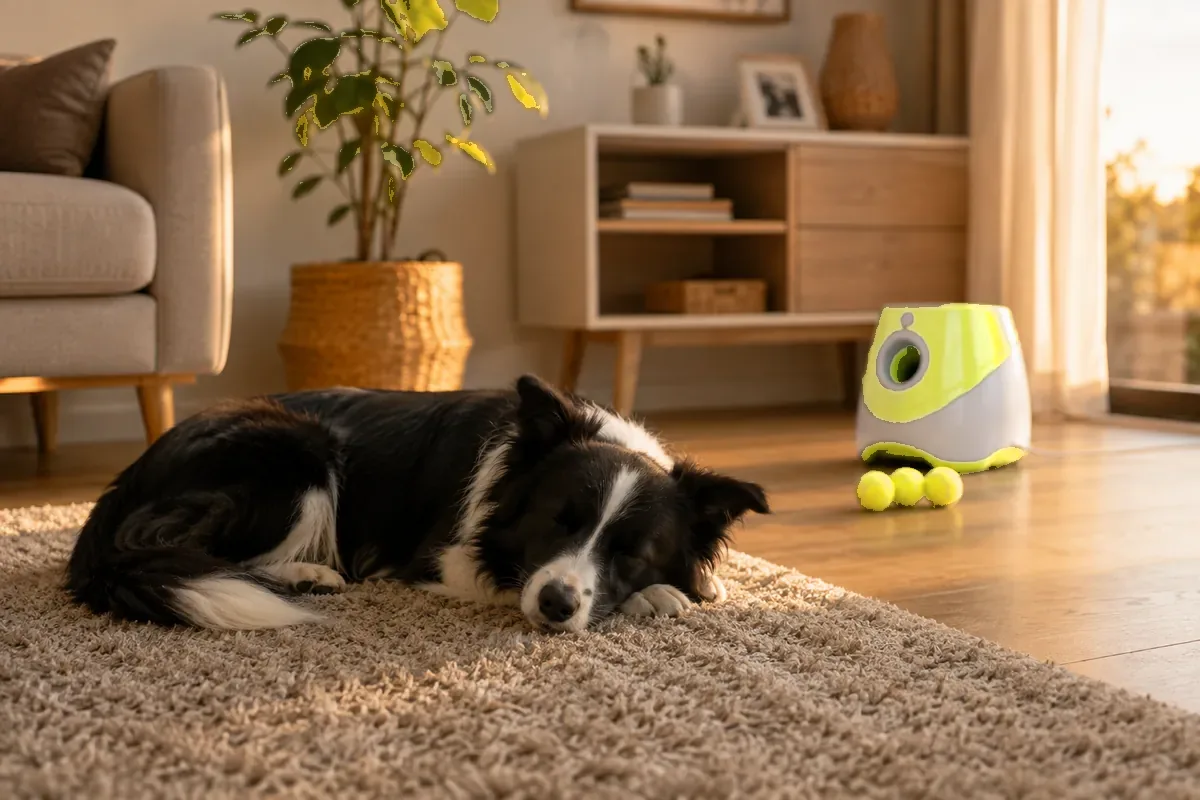
That adds up to roughly forty-five minutes spread across the day, most of it indoors, and it produces a dog who sleeps. An hour and a half of continuous walking in the rain produces a fitter dog and a wet owner.
What none of this replaces
Indoor work does not replace going out. A dog needs to sniff, to explore and to meet others, and none of that happens in a living room. On the days you can get out, get out. This guide is for the other days — and there are more of them than anyone plans for.

Erin Delaney · Dog trainer, specializing in working off energy
Erin has spent twelve years working with companion dogs in cities, mostly active breeds living in apartments. She writes the Pupserve guides and reads every product page before it goes live.